mercoledì 30 ottobre 2013

ROYAL FAMILY

British Royal Family
The British Royal Family is the family group of close relatives of the monarch of the United Kingdom.  The Royal Family usually include the monarch, the consort of the monarch, the widows and widowers of previous monarchs, the children of the monarch, the male-line grandchildren of the monarch and previous monarchs, and the wives or widows of a monarch's and previous monarch's sons and male-line grandsons.
After 1917, when King George V changed the name of the royal house from Saxe-Coburg and Gotha, members of the Royal Family belong, either by birth or marriage, to the House of Windsor. Senior titled members of the royal family do not usually use a surname, although since 1960 Mountbatten-Windsor (incorporating Prince Philip's adopted surname of Mountbatten) has been prescribed as a surname for Queen Elizabeth II's direct descendants who do not have royal styles and titles, and has also sometimes been used when required for those who do have such titles. Members and relatives of the British Royal Family historically represented the monarch in various places throughout the British Empire, sometimes for extended periods as viceroys, or for specific ceremonies or events. Today, they often perform ceremonial and social duties throughout the United Kingdom and abroad on behalf of the United Kingdom. Aside from the monarch, their only constitutional role in the affairs of government is to serve, if eligible and when appointed by letters patent, as a Counsellor of State, two or more of whom exercise the authority of the Crown (within stipulated limits).

File:The British royal family on the balcony of Buckingham Palace.JPG
British Royal Family.

Family tree of members

King George V
Queen Mary
King George VI
Queen Elizabeth
Prince Henry, Duke of Gloucester
Princess Alice, Duchess of Gloucester
Prince George, Duke of Kent
Princess Marina, Duchess of Kent
The Duke of Edinburgh
Queen Elizabeth II
The Duke of Gloucester
The Duchess of Gloucester
The Duke of Kent
The Duchess of Kent
Princess Alexandra, The Hon Lady Ogilvy
Prince Michael of Kent
Princess Michael of Kent
Diana, Princess of Wales[N 1]
(div. 1996)
The Prince of Wales
The Duchess of Cornwall
The Princess Royal
The Duke of York
Sarah, Duchess of York
(div. 1996)
The Earl of Wessex
The Countess of Wessex
The Duke of Cambridge
The Duchess of Cambridge
Prince Harry of Wales
Princess Beatrice of York
Princess Eugenie of York
The Lady Louise Windsor
Viscount Severn
Prince George of Cambridge

Prince William and Kate Middleton' marriage.

Prince George of Cambridge (George Alexander Louis, born 22 July 2013) is the only child of Prince William, Duke of Cambridge, and Catherine, Duchess of Cambridge. The only grandchild of Charles, Prince of Wales, and Diana, Princess of Wales, he is third in line to succeed his great-grandmother, Queen Elizabeth II, after his grandfather and father. Royal baby.
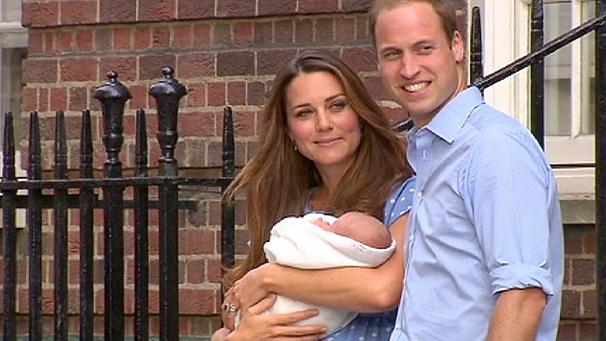
George is baptised by the Archbishop of Canterbury in the Chapel Royal at St James's Palace on 23 October 2013, with Oliver Baker, Emilia Jardine-Paterson, Hugh Grosvenor, Earl Grosvenor, Jamie Lowther-Pinkerton, Julia Samuel, William van Cutsem (son of the late Hugh van Cutsem) and Zara Tindall serving as godparents. The ceremony used a font that was made for Queen Victoria's first child and water from the River Jordan.

Il battesimo del royal baby


lunedì 21 ottobre 2013

HALLOWEEN

Halloween, also known as All Hallows' Eve, is a celebration observed in a lot of countries on October 31. It's the eve of the Christian feast of All Hallows (or All Saints), the day dedicated to remembering the dead, the saints and the martyrs. All Hallows' Eve is a feast influenced by Celtic harvest festivals, and festivals of the dead with  pagan roots, particularly the Gaelic Samhain.
Typical festive Halloween activities include trick-or-treating (also known as "guising"), costume parties, pumpkins into jack-o'-lanterns, lighting bonfires, apple bobbing, visiting haunted attractions, playing pranks, telling scary stories, and watching horror films.
The history of Halloween is not entirely a clear one.Many hundreds of years ago, a people called the Celts lived in Europe and on the British Isles. The Celts believed that the souls of the dead visited Earth on the last day of October. They had a festival in honor of these souls of the dead, and they called it Samhain. In time, the Roman Empire conquered the Celts and took over some of their beliefs. This included Samhain. The Romans combined it with their own festivals. And since the Roman Empire spread across a great part of the known world, the idea that the souls of the dead visited Earth on the last day of October spread far and wide. Many ideas from the Roman days still survive in the United States and in other Western countries. Halloween is one of them. But how did we get the name Halloween? In the 8th Century, the Catholic Church declared November 1 to be All Saints' Day. November 1 was picked to be the day to honor all saints who didn't already have a day named in their honor. And the mass that the Catholic Church celebrated on November 1 was called Allhallowmas. This meant "mass of all the hallowed [saintly people.]" It was commonly called "All Hallows' Day." And somewhere the night before the "All Hallows' Day" became known as Allhallowe'en, which was short for "evening before All Hallows' Day." It was then shortened to what we now call it, Halloween. One last question: Why do people dress up as ghosts, goblins, vampires, and other scary creatures? The people who started all this Halloween business many years ago believed that if they appeared scary, they would scare away the spirits of the dead who were roaming the earth on All Hallows' Eve. These people also carried food to the edge of town and left it there, hoping the spirits would eat that food and not come raid the village

lunedì 7 ottobre 2013


ENGLISH IDIOMS
Idioms exist in every language. An idiom is a word or phrase that is not taken literally, because it has a figurative meaning. Some English idioms are:


It's raining cats and dogs. It means it's raining really hard.
A bird in the hand is worth two in the blush. A certain thing is better than two impossible.
A paper tiger. It means that a person pretends to be brave and powerful, but in reality she isn't that.
  • A chip on your shoulder - means you think you know a lot.
  • High as a kite - means you are drunk or on drugs.
  • Sick as a dog - means you are very ill.
  • In dance, "break a leg" means good luck.
  • "Out of the blue” means something happens that was unexpected.  
  • The blues” can refer to both a style of music and feeling sad.
  • Rub someone the wrong way - meaning to annoy or bother.
    •    Jump the gun - would mean to be doing something early.
    •    Pay the piper - means you need to face the consequences of your actions.
  • An alley cat - means that a person go in places to obtain food.
  • the jewel in the crown
    If something is the jewel in the crown, it's part of a group or set of similar things, and it's the best of them all.

    a bad hair day
    If you're having a bad hair day, everything seems to be going wrong for you. ighten your belt, you try to spend less money.

    wear your heart on your sleeve If you wear your heart on your sleeve, you show your emotions openly and you don't try to hide your feelings.

    work your socks off | work your tail off If you work your socks off, or work your tail off, you work very hard.

    Achilles' heel
    An Achilles' heel is a weakness that could result in failure.


    domenica 12 maggio 2013

    "THE KISS" of Gustav Klimt
    "The kiss" is a portrait created by Gustav Klimt. In this portrait there are a couple of lovers, they are embrassed and the boy is kissing the girl's cheek. They are in a flowery meadow. The portrait is very coloured, the predominant colour is the yellow. In fact, the lovers are dressed with this colour, that united their bodies in a warm hug. But there also the colours green, white, red and brown. There are also many coloured flowers. The lovers are very pale, but the girl has got very red lips, that stand out in the portrait.

    domenica 10 febbraio 2013

    Narrative poem

    A narrative poem is a long story in vers that contains many narrative elements. In fact there are desciptions of the characters, there is the use of a narrator and there is the setting in time and place. It's written in Middle English. It's often in the first person. In Middle Ages there were many genres of narrative poem: the "examples", that have a moral teaching from real events or fantastic situations; the romance, that is about love and war; and the fabliau, that is comic and it's about sex. The goal of the narrative poem is to teach values and to give a moral. It tells about the changing of the society from a religious view to a lay outlook. The greatest example of a narrative poem in medieval literature is "Canterbury's Tales", written by Geoffrey Chaucer.It's a long poem in vers, framed by a General Prologue. It's set in Canterbury, Jerusalem, Rome and Santiago of Compostela. It tells about all the society except the aristocrats.

    domenica 3 febbraio 2013

    Ballads

    A ballad is a poetical composition in vers that is performed as a song. It's a short narrative song. The word "ballad" derives from the Latin and means "dancing". Balllads originallly were transmited orally and they were accompanied by music. Scops entertained people with ballads in the halls of kings. Only then ballads were written in Old English by anonymous writers. The characters of ballads are kings, heros, and warriors. The ballad tells a dramatic story as a series of rapid flashes. It focuses on a single crucial episode and it tells dramatic events. In ballads there are many refrains, repetitions and poetical devices like alliterations, kennings, assonances and consonances. There are formulaic phrases and stock-images. Popular ballads are a mixture of dialogue and narration. They are impersonal, so the ballad's narrators don't speak in the first person. Ballads have many themes: love; war between English and Scottish people; border ballads; ballads of outlaws, like Robin Hood; family tragedies; and ballads of magic, about fairies, ghosts and witches. Ballads have many stanzas, and each stanza is made up of  four lines: two questions and two answers.

    domenica 30 dicembre 2012

    EPIC POEM

    The epic poem is a long narrative composition in vers. The word "epic" derives from the Greek word "épos" that means "the poet oral composition". The epic poem is a part of poetry. The first examples of epic poem are the Iliad and the Odyssey of the Greek poet Homer. Then there are the Aeneid of the Latin poet Virgil, and the Anglo-Saxon poem Beowulf. The epic poem is a recollection of a glorious past. It tells the deeds and the adventures of the heros. In deeds there are storic and fantastic elements. There are supernatural powers and characteristics. The characters of the epic poem are heros, kings and monsters, like dragons. The setting are forests and castles; and the language is formal and classic. The themes of the epic poem are deeds, funerals and struggles. The society described is aristicratic and military. In the epic poem there are: a destiny, an invocation to a muse, tales and speeches, an incipit a medias res, a divine intervetion in human affairs and the values of heros.